
Seen & Celebrated
Illustrations By Gabriella Trujillo
The Grand Entry gets her every time.
It is the ceremonial opening of CSUN’s beloved annual Powwow, which just celebrated its 40th year on campus, and the pageantry takes Debbie Martinez-Rambeau’s ’75 (Liberal Arts/Chicano Studies), M.A. ’81 (Elementary Education) breath away whenever she attends. Veterans are honored, new babies are blessed and those who are ailing receive prayers from spiritual leaders.
“Grand Entry is so beautiful because everyone is in regalia,” Martinez-Rambeau said. “As people enter the circle, they are blessed by the spiritual leader.”
While powwows are traditionally celebrated by Southern and Northern Plains tribes, the university’s pan-tribal event — which takes place in November — incorporates participants and customs from more than 30 different tribes, including songs from members of the Fernandeño Tataviam Band of Mission Indians and Chumash Bear Dancers.
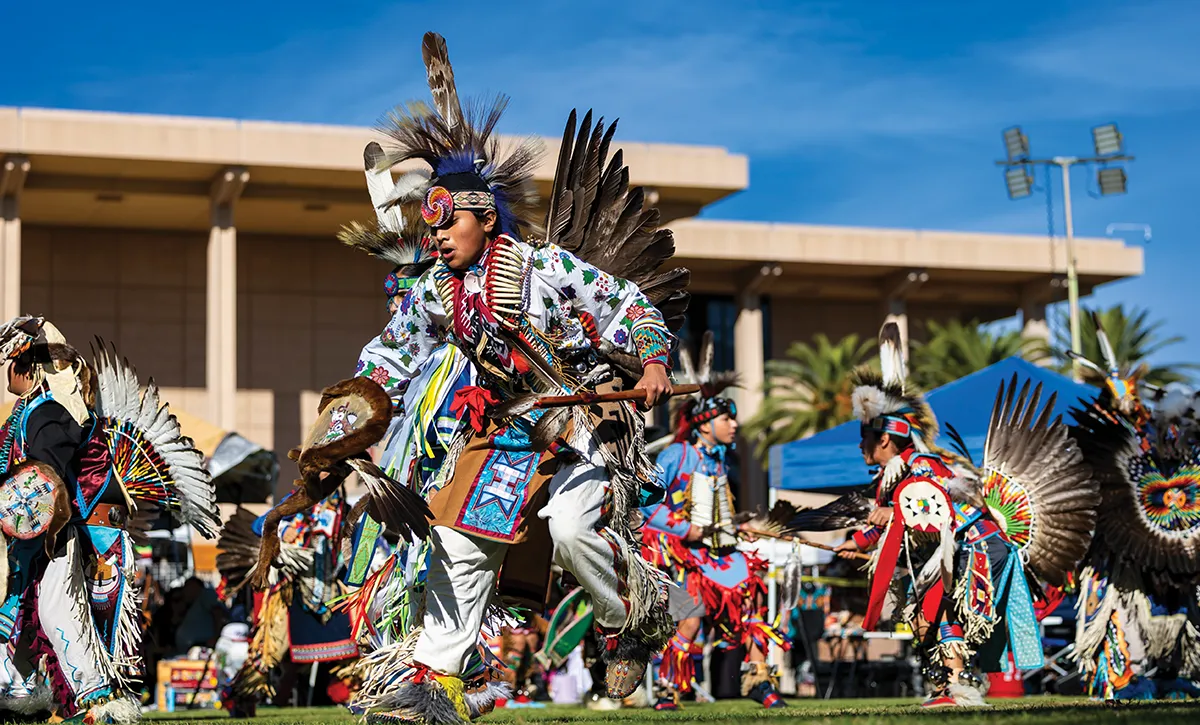

Now serving as a tribal elder and chair of Yaquis of Southern California, Martinez-Rambeau helped found the CSUN Powwow in the 1970s, when she and fellow American Indian students channeled the energy of the Red Power movement to celebrate and showcase their Native cultures on campus. Despite a two-year hiatus during the COVID pandemic, the Powwow returned in 2022 and has grown to attract more than 1,000 people each year.
The Powwow is just one way CSUN sees and celebrates Indigenous people, both on campus and throughout the community, Martinez-Rambeau said. In fact, the university has a long history of promoting a better understanding of American Indian history, cultures and tribal sovereignty.
“CSUN is at the forefront of acknowledging the needs of the Indigenous community,” Martinez-Rambeau said. “Kudos to CSUN.”
Milestone Anniversaries
Program Director Teresa Williams León said many Matadors are introduced to courses in American Indian studies when they enroll to fulfill general education or ethnic studies requirements, but they frequently enjoy their classes so much they declare a minor.
“Non-Native students come into our classes probably thinking about past peoples, or that everyone lives on reservations and they are a dwindled population,” Williams León said. “But they learn that Indigenous people are a people of today.”
Some students are surprised to learn that Los Angeles is home to a large urban population of Native people, and that California has the most federally recognized tribes in the United States, Williams León said.
“Native people are a thriving people,” she said. “They have businesses, they’re community leaders, they’re involved in environmental struggles. Students are also surprised to learn that many of the tribes and nations are some of the largest employers in the state, and we’re not talking about casinos. We’re talking about the medical field, entertainment, law, education, social work and business.”
Williams León said the program influences graduates of colleges and departments across the university. CSUN students have paired a minor in American Indian studies with majors in business, filmmaking, history, anthropology, psychology, Chicana/o studies, urban planning, criminology and law, to name a few.
New Bachelor’s Degree Proposed
The number of CSUN students who self-identify as American Indian or Native Alaskan is small, at just 29 in fall 2024, but that number doesn’t tell the full story of the university’s Indigenous student enrollment, Williams León said.
“If we include members of the Chicano community, Central American communities and South American communities who might be falling under the umbrella of Latino, the Indigenous population at CSUN is much larger,” she said.
Williams León noted that the university’s relationship with the Tataviam tribe and five decades of offering courses in American Indian studies have created a strong post-graduate network for Indigenous students. She lauded previous director Scott Andrews, a professor of English and American Indian studies and citizen of the Cherokee Nation of Oklahoma, among the team of educators who helped build the program — which incorporates the arts, literature, philosophy, sociology, history and the sciences.
Going Beyond Land Acknowledgement
CSUN’s commitment to First Nations and Indigenous people goes beyond a campus land acknowledgement and observing Native American Heritage Month every November, she said. Williams León’s role also includes guiding campus strategies and practices to ensure an inclusive climate that supports a thriving community of Indigenous students.
“It’s a really important position that demonstrates CSUN’s commitment to engaging and reaching out to Native students to create an educationally and holistically conducive and supportive environment,” she said. “It ensures we stay connected to the people whose land our institution occupies.”
CSUN partners with the Tataviam Band, which is based in San Fernando, on various initiatives — including the university’s first Native Youth Conference, where high school juniors and seniors visited the university in March to learn about educational opportunities.
CSUN is serious about empowering Native students and about developing programs and partnerships, Williams León said. “[This] also lets the larger CSUN community know that Native people are here, and they are thriving and we are going to work closely together to honor them and uplift their voices.”
Martinez-Rambeau agreed, noting that CSUN’s commitment proves to the public that Native people “are not just these pictures from history,” she said. “We’re still here. Work with us now.”
Indigenous Student Engagement
Martinez-Rambeau frequently speaks to American Indian studies classes and volunteers with AISA, to help students learn tribal protocols in preparation for the CSUN Powwow. A celebrated gourd artist whose work has been showcased worldwide (Yaqui people use gourds as drums and rattles), she teaches sewing, gourd art and sage bundling so CSUN students can make and wear traditional garments and present gifts to their elders and sponsors at the Powwow.
“Since 1970, we’ve grown so much and it’s exciting to see students from so many backgrounds, including those who are LGBT or Two-Spirit — and those who are saying, ‘I’m Indigenous,’ or ‘I’m American Indian’ for the first time, and figuring out what that means to them and who are their people,” Martinez-Rambeau said.
Showcasing Indigenous Culture
CSUN also hosts Native-focused events and brings notable speakers to campus, including a recent appearance by Chief Angel Geronimo Sanchez Reyes (a direct descendant of Geronimo) and Vice Chief Andrew Aranda of the N’de Apache Nation, according to Williams León.
The American Indian Studies program also partners with public and charter K-12 schools to introduce Indigenous students to CSUN and create a pipeline for students to apply and enroll.
“We want them to study American Indian and Indigenous interdisciplinary studies and get them excited about this field,” Williams León said. “But mainly, we want Native students to have a supportive environment so they can go to college and major in whatever they want to study.”
Celebrating Native Graduates
“Shy’oot means star in the Gabrielino-Tongva language,” Williams-León said.
One Tataviam alumna who participated said she was gifted a sash made by a member of her tribe. “It was a really beautiful ceremony,” said Jenée Ornelas ’19 (Early Childhood Development). “I got emotional. It was like a full-circle moment to have members of my tribe there.”
Ornelas, the granddaughter of former Tataviam tribal leader Rudy Ortega Sr., worked for the tribe’s Educational and Cultural Learning Department while attending CSUN, eventually becoming department director. Her role included connecting tribal youth to programs at CSUN, such as the Ethnic Studies Education Pathways Project.
“I’ve always wanted to share my experiences and let Native youth and students know that there is help out there, that if they want to go to CSUN — they can,” she said.
Today, Ornelas serves as the first-ever Tribal Liaison for the Los Angeles County Department of Parks and Recreation, working with the 26 tribes whose ancestral homelands fall within the county’s roughly 4,084 square miles.
“Working for my tribe while I was a student at CSUN developed me as a person,” she said. “But the leaders of my tribe not only encouraged me to be proud of the work I was doing, [they] also told me to go out and spread my wings.”
Among her many responsibilities for the county, Ornelas is working with tribal leaders to restore interpretive exhibits at the Eaton Canyon Nature Center, which burned during the January 2025 wildfires.
“My focus is on engaging with tribes and being a bridge to L.A. County for projects and programming,” she said.
Ornelas said she finds time to return to the CSUN Powwow every fall to see friends from her tribe, the campus and the community. She also named the Grand Entry as her favorite moment of the event.
“It is intergenerational,” Ornelas said. “You see the elders with the youth, and the little children and new babies are presented to the community. [The Powwow] is always on my calendar. I always take my family, and I encourage my coworkers to attend.”
Sharing Knowledge Across Generations
“In American Indian culture, being an elder is an advantage,” she said. “We respect elders. I let the students know that we respect those who have gray hair. It means that we’ve aged to the point where we can share our knowledge with you, whether it be dance, crafts, medicine, spirituality, love, family, being humble. All of it. We share with you.”
CSUN students return to her seminars year after year, to thank her for sharing her wisdom and tribal knowledge.
“It’s so exciting to see their enthusiasm and their interest,” she said. “And it’s still exciting for me to be part of CSUN.”
Notable Native Alumni
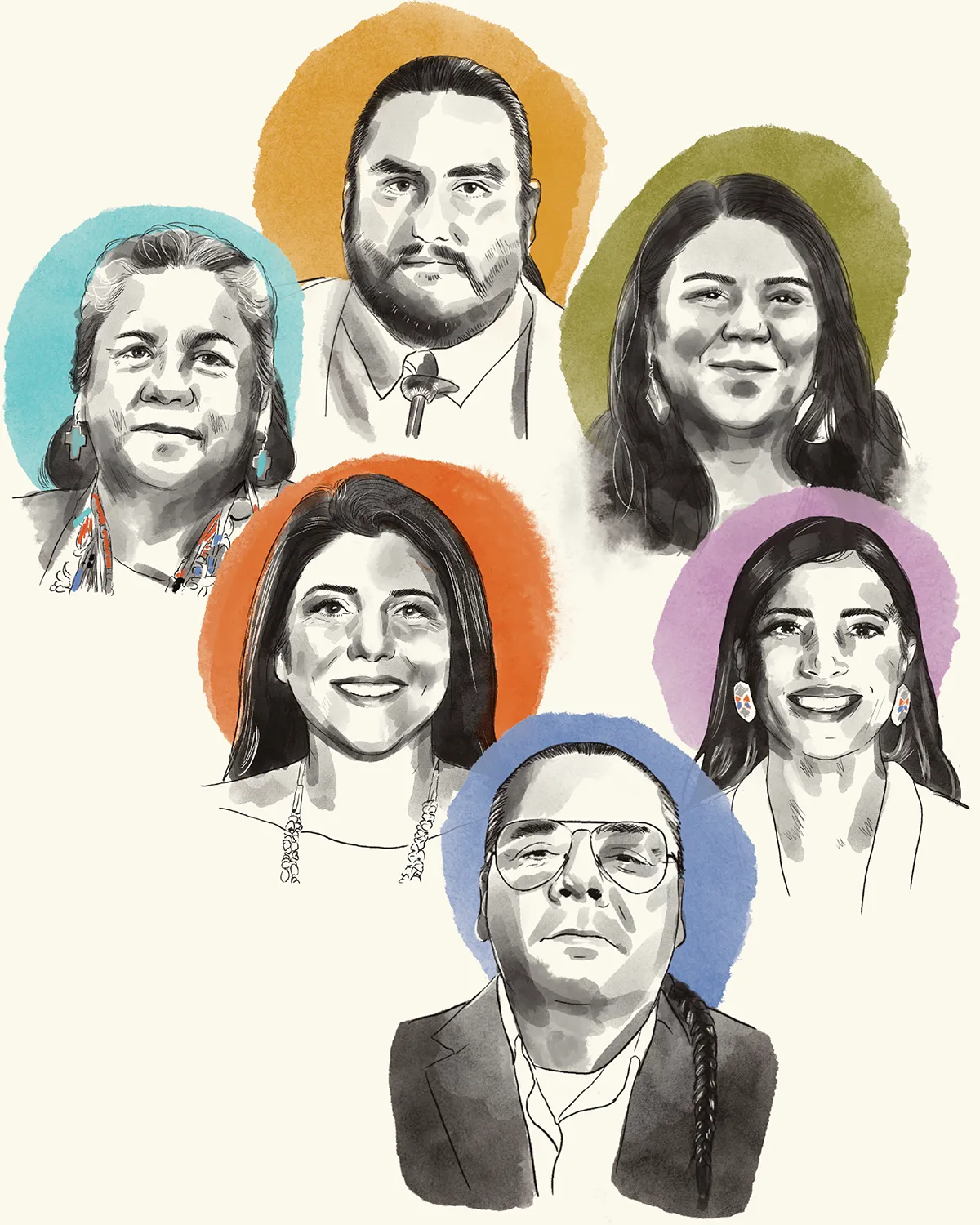
Jenee Ornelas ’19 (Early Childhood Development)
attorney Rosemary Avila ’08 (Sociology)
social worker Rene “Yaotl” Orozco ’90 (Anthropology), M.S.W. ’16 (Social Work)
Debbie Martinez-Rambeau ’75 (Liberal Arts/Chicano Studies).