

Better Living Through Engineering
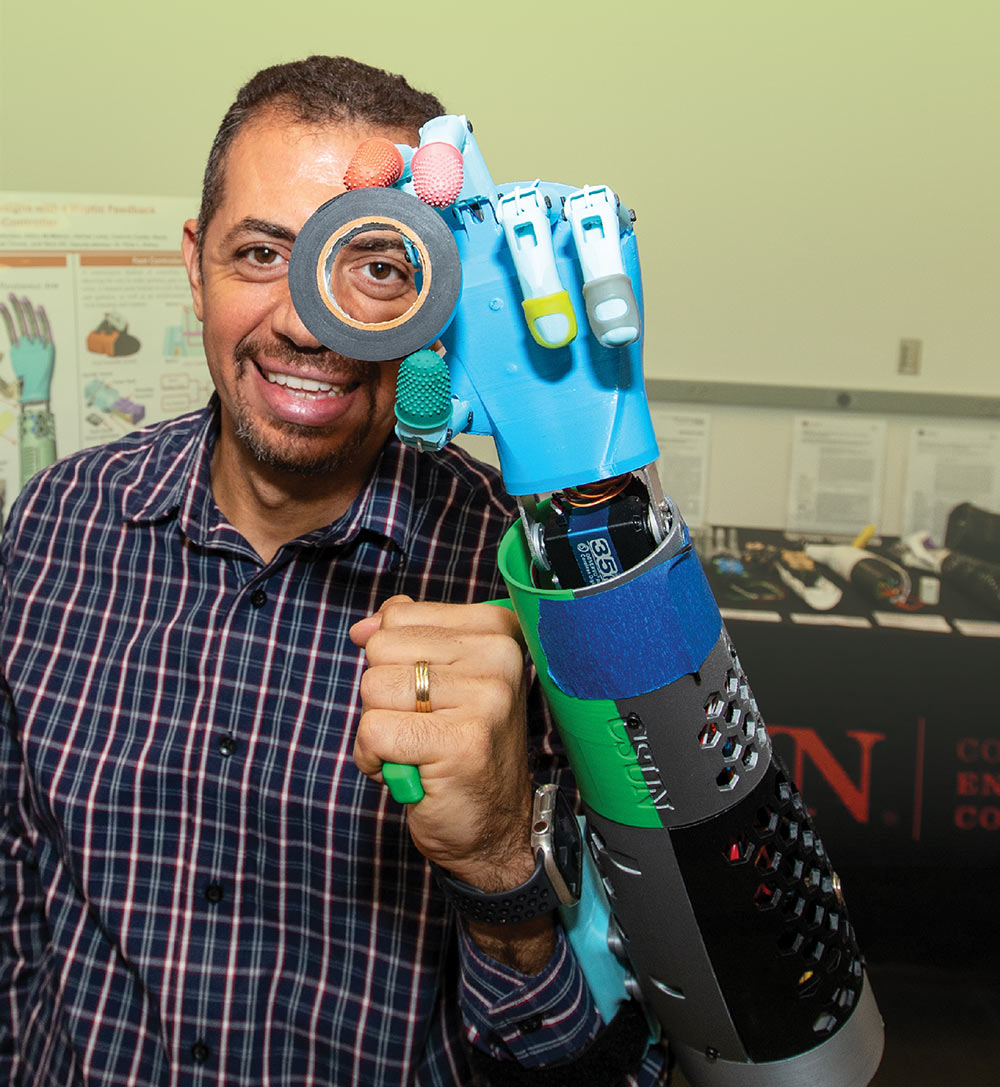
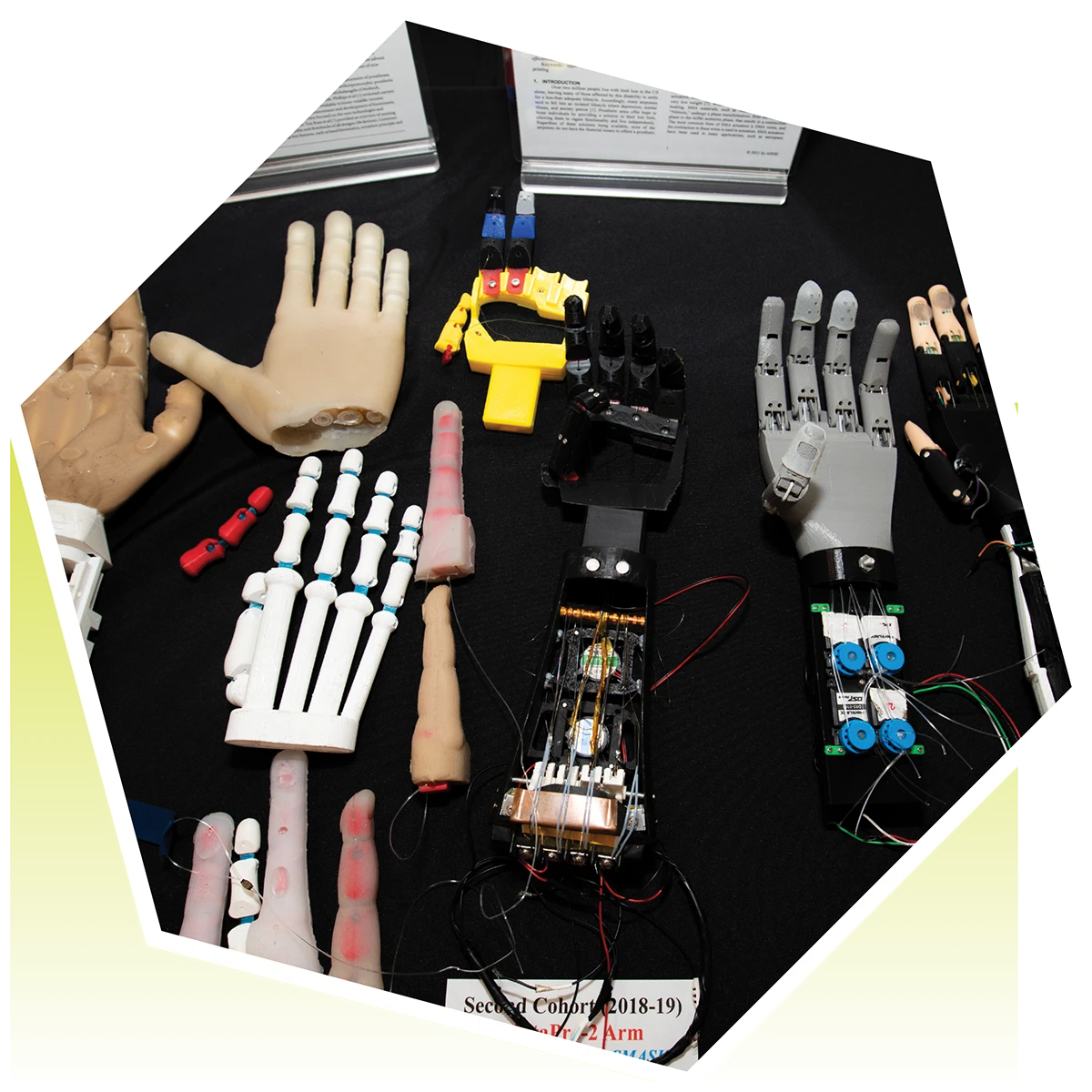
echanical engineering professor Peter Bishay had prepared a hands-on exhibit and multimedia presentation about the Smart Prosthetics Senior Design Project. He’d filled a table with prosthetic hands and arms created by his engineering students over nearly a decade of research and design — and insisted that visitors pick them up and try them out. The sleek, 3D-printed hands and arms, with the wires and motors exposed, represented years of experimentation. Bishay’s pride shone through each carefully documented element, telling the story of how a senior design project at CSUN grew into an ambitious, multidisciplinary research effort aimed at making prosthetic technology more intuitive and useful for the people who depend on it.
“Most of the students [say], ‘I want to use my engineering skills to help others,’” Bishay said. “We are coming up with great innovations, integrating virtual reality, AI and different new technologies in the work we’re doing, and that’s amazing.”
Their work has been published in professional journals, generating research in the biomedical field and fueling efforts to make a better experience for prosthetic arm users and promote long-term wear.
Bishay and his students are also developing a new system to help prosthetic arm users “feel” different textures. Students from last year’s cohort added to the innovations, creating a wear-able robotic arm — as a temporary aid for people with injuries or for an augmentation experience.
It all started with students’ need for a capstone project, and Bishay’s interest in a material with unique properties.
Early Days
Senior design projects are a year-long endeavor for cohorts of engineering students. In CSUN’s Andrew J. Anagnost College of Engineering and Computer Science, that culminates with a showcase in May, where students’ work is judged by industry professionals. In 2017, Bishay’s department chair asked him to create another new capstone project for a group of students still seeking to enroll in this required culminating practical experience. At that time, Bishay was interested in research on a multi-functional material.
“I was reading a paper about shape-memory alloys and how they can be used in prosthetic arms,” he said. “Then, I found out that there were some mechanical engineering students interested in medical devices and biomedical engineering. At the same time, I was limited in space … So, I decided to establish the Smart Prosthetics Senior Design Project. Our approach at that time was to design a biomimetic transradial (below-the-elbow) prosthetic arm.” Biomimetic refers to an artificial limb that’s designed to mimic how a human limb — in this case, an arm and hand — would move.
Problems to Fix
The Students
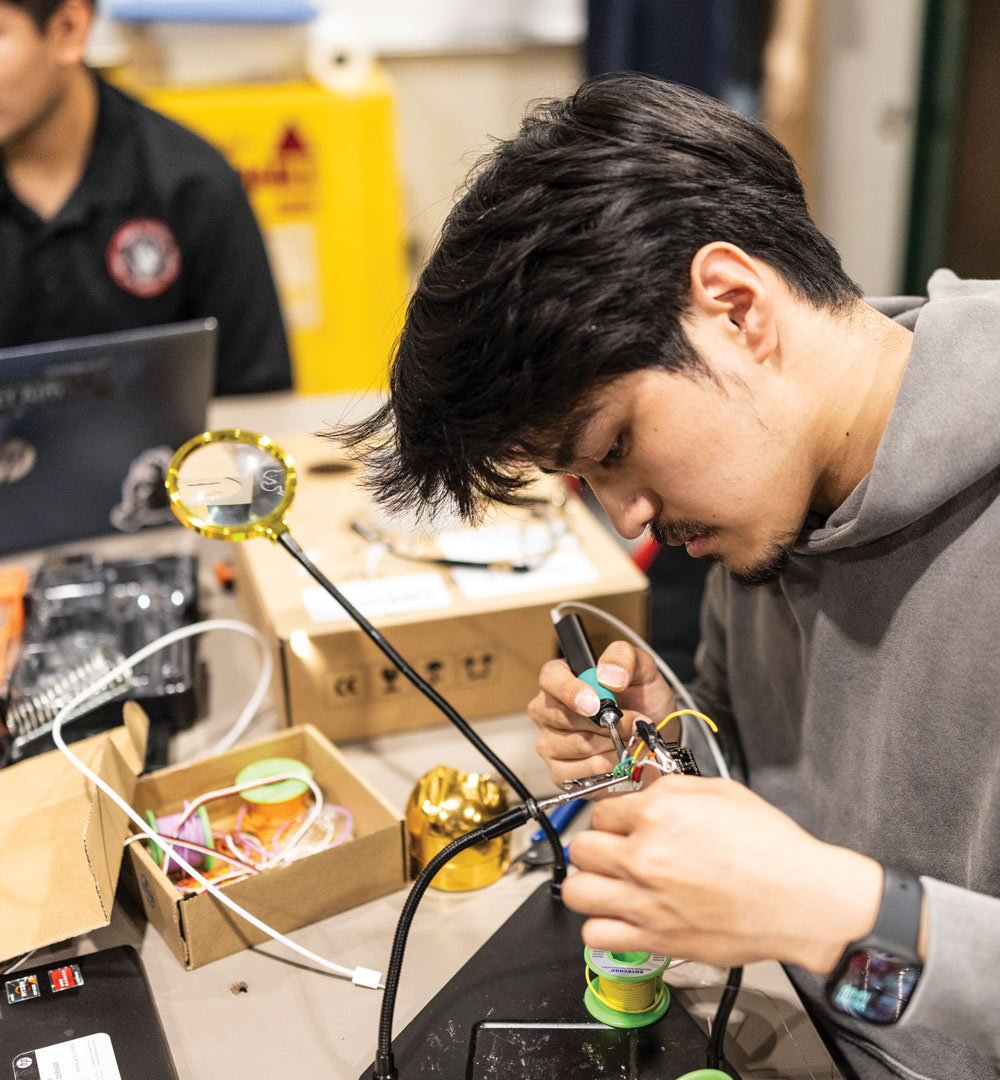
“My sub-team had a couple of people that were really good with coding. I’m pretty gifted on the mechanical side of things,” Trocino said. “And we had one guy who’s like a jack-of-all-trades, who understood the electrical, the software and the mechanical.”
Trocino served as a team lead for the foot-controller sub-team. He was one of the presenters at the Senior Design Project Showcase and at CSUNPosium, an annual student conference and exhibition featuring students’ scholarly research and creative activity.
Trocino already had a job lined up after graduation in May and began work as an assembly manufacturing engineer at Teledyne Technologies, which develops engineered systems for aerospace, defense and industrial markets. He said his experience on the senior design team helped him land the job.
“For the job interview itself, I had to give a 20-minute presentation on my relevant technical experience, and one of the project examples I talked about was my contribution to my senior design team,” he said.
As the students’ work advanced, so did their expos-ure to key innovations. In the past few years, they began working with artificial intelligence (AI) technology called Generative Design, created by Autodesk, within its computer-aided design software Fusion.
Advancing the Research
“A shape-memory alloy material is considered ‘smart’ because it has multi-functionality,” Bishay said. “For example, if you heat the wire by running electric current through it, it will shrink. And because it is metal, when it shrinks, if it is connected to a flexible object, it will pull the object — it works as a very lightweight actuator. In mechanical engineering, we use actuators to move the mechanisms we design.”
That first cohort, made up of 18 undergraduate students and Bishay, published a research paper in 2020 on their work using the shape memory alloy wires within 3D-printed “bones” connected by flexible, 3D-printed joints, all within a silicon “flesh.”
“This paper [has been] cited multiple times since it was published,” Bishay said. “Last year, some researchers extended this idea to further develop a design of a hand that has more degrees of freedom than our hand … So, our ideas benefited a lot of researchers.”
A Prosthetic Arm Controlled by … Your Toes?
“If these sensors shift away from their intended locations, they might not be as accurate — since they are supposed to target specific muscle groups,” he said. “Also, those who have no residual limb at all, or no muscles in the residual limb, cannot use this technology that is currently dominating the market of prostheses.”
Bishay and students in the fifth cohort of Smart Prosthetics developed a foot controller that’s operated by pressing two buttons in a thin, flexible insole with the toes, to perform a variety of functions. The electronics are housed in a small box, called the sensor controller unit.
“Whether you do a single-click, double-click [or] long-click with the toes, you can do different things, like different grips and gestures,” Bishay said. “It’s wireless. It’s immediate. And it is very easy to use.”
In 2024, Bishay filed a utility patent application — currently pending — for the technology.
A New Way to Train
“VR is enabling us to train users on doing tasks without carrying the physical weight of the arm, and this is one great advantage. It’s [also] taking out some of those psychological barriers,” Bishay said. “You feel that you are alone in this VR world. If anything happens, it’s just a game.”
In 2022, the team was awarded a three-year grant by the National Science Foundation to create a seven-week training program. Some participants did the training using the physical prosthetic arm and controller to pick up blocks and sort them into bins. Other participants used VR headsets and manipulated a virtual arm in a virtual lab setting, while a computer tracked the user’s performance, motions and gaze.
To restore the sense of touch, Bishay and students began designing a haptic feedback system, also called tactile feedback. The image detection system consists of a small camera secured to the wrist. As the fingers touch an object, a video is recorded and translated to an image-classification model. Another system applies a gentle rubbing motion on the skin of the remaining limb, sharing the “feel” of the object.
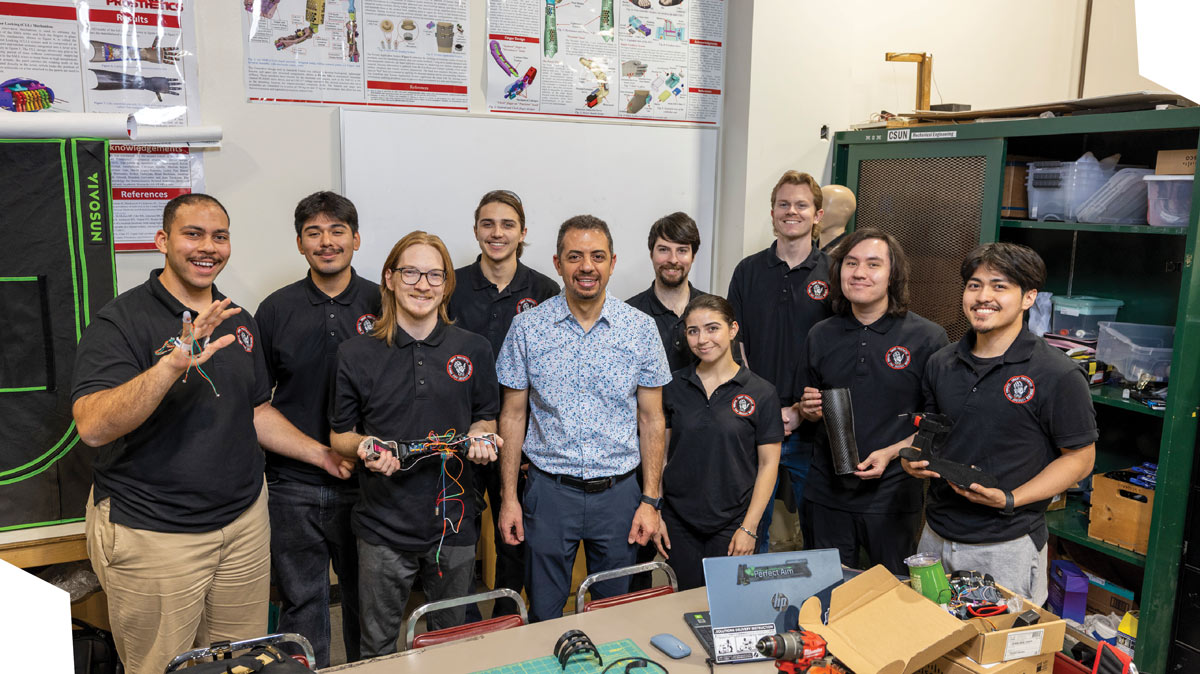
Professor Peter Bishay (center) and student members of the Smart Prosthetics Senior Design Project team show off some of their work in the Design SMART Lab.
What About Those Who Need Temporary Assistance?
“I wanted to expand the range of potential users of the arms we develop — so that we can help not only those who have upper-limb difference, but also those who need a third arm because of a temporary injury or special work that requires another hand,” Bishay said.
As the prosthetic arm research has expanded, so has the work on Bishay’s original senior design project.
The Smart Morphing Wing
This academic year, Bishay said, he and his students will focus on developing a drone with vertical take-off and landing capability that can perch and handle a payload.
What’s Next
For Bishay, the technologies themselves, while exciting, are only part of the story.
“We are not a company trying to profit from the products we develop,” he said. “We are an educational institution. In addition, our work is mainly focused on applied research.”
This mission, he said, produces lasting outcomes. One is sharing new discoveries with the broader scientific community through published research. Another is pre-paring the next generation of engineers and problem solvers.
“My most important product is the student,” Bishay said. “These students learn so much throughout the year, and then they go into industry and use those skills to change the world around them. I am trying to make my Design SMART lab a place where dreamers can make great achievements that they can remember for the rest of their lives; a place where innovators are polished and sent to society to shine … through transformative ideas and solutions.”