

Are We Alone in the Universe?


Illustrations By Ollie Hirst
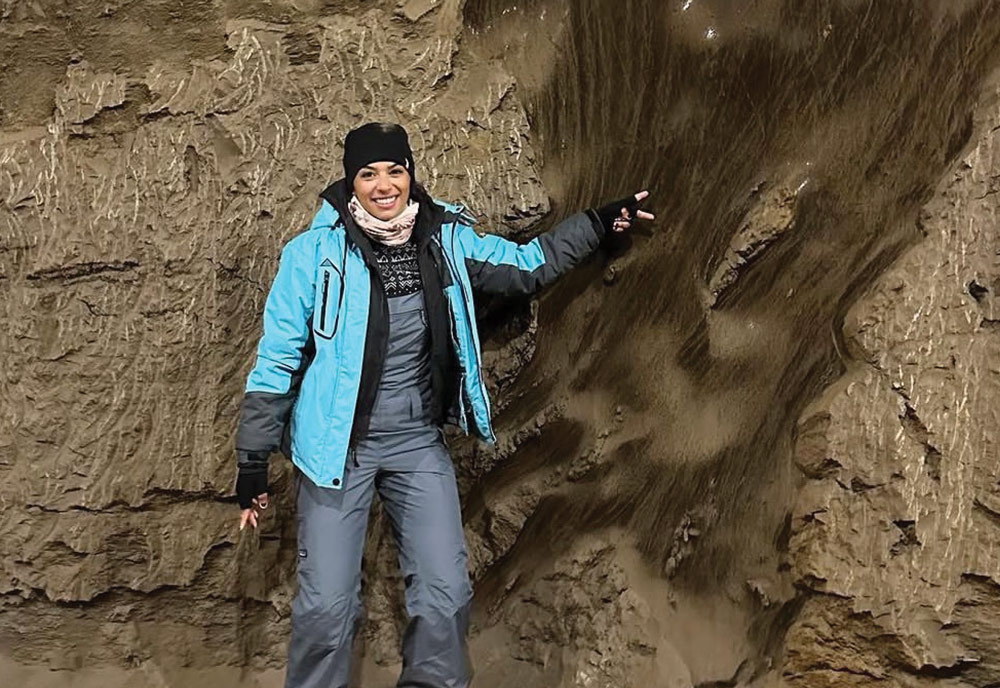
Biology graduate student Carolina Gonzalez walked through the dark, dusty tunnel a few miles from Fairbanks and marveled at the walls. Some sections were pure, smooth ice. Others were frozen soil, flecked with the remains of animals and plants from thousands of years ago — she could see fragments of mammoth bones and even the horn of an extinct bison.
“Wow, I never experienced this in my life before,” Gonzalez later recalled thinking. “It feels like going to a museum.”
Biology professor Rachel Mackelprang brought Gonzalez, fellow graduate student Serena Hernandez and staff research associate Mike Snyder into the U.S. Army Corps of Engineers Cold Regions Research and Engineering Laboratory permafrost tunnel in 2024 for a National Science Foundation-funded study with implications for NASA. In the soil that forms the tunnel, microbes are frozen in place, forming little communities where nothing gets in or out. Each step deeper into the tunnel is a step further back in time, into the last Ice Age. Soil near the entrance froze some 12,000 years ago. Further back, 40,000.
Gonzalez drilled into the earth with a sample corer, which starts with a pull cord like a lawn mower. She and Hernandez collected soil samples, and the microbes living in those samples, at various points in time to see what happens after thousands of years of isolation at below-freezing temperatures — what lives, what dies and what genes make the difference.
Mackelprang’s expertise is so respected in the field of astrobiology that she literally helped write the rules for safely bringing back samples from space (more on that later). She’s just one professor in a diverse group of CSUN researchers whose work may help answer one of life’s most profound questions: Are we alone in the universe?
Colleges across campus are addressing this question. Much of the work is done in the Andrew J. Anagnost College of Engineering and Computer Science and the College of Science and Mathematics. Students in psychology, business, food science and many other fields also collaborate through the NASA-sponsored CSUN ARCS (Autonomy Research Center for STEAHM, where STEAHM stands for science, technology and engineering, entrepreneurship and business, arts, humanities and mathematics).
These researchers are finding extraterrestrial spots where life could exist and identifying the types of organisms that might be there. They’re developing tools to help us look deeper into space, training new rovers and designing helicopters to search other worlds. They’re building systems for astronauts to survive when they boldly go deeper into our solar system.
These are life-changing career-preparation opportunities. Many students, including Gonzalez, have interned at NASA, working alongside some of the world’s most brilliant minds. More than 400 CSUN alumni now work at NASA and SpaceX, Blue Origin, Aerojet Rocketdyne, and other aerospace and related companies.
The search for living — or even extinct — species on other worlds provides new knowledge about the universe and our place in it.
“There was a beautiful photo of a dot in the galaxy, and the dot says ‘Earth,’” said biology professor Chhandak Basu, who partners with NASA. “The moment you see that, you understand that we are no one — at the end of the day, we are a dot in the galaxy. So, similarly, if you can find life on another planet, it makes you humble.”
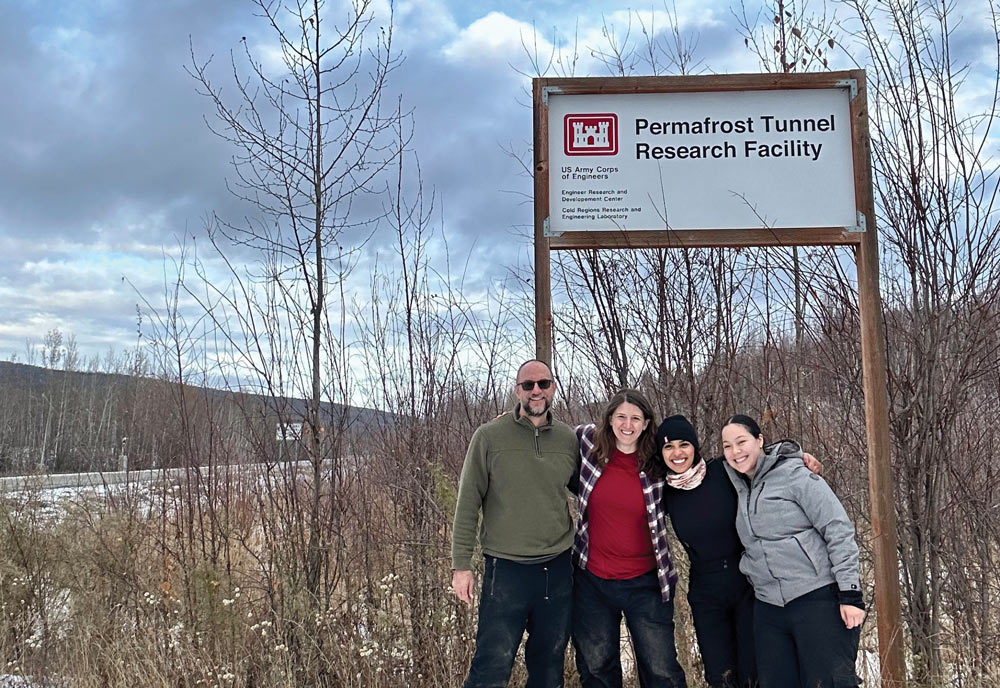
Biology professor Rachel Mackelprang (second from left), graduate students and a research associate study the Alaskan permafrost, for insights into what could thrive elsewhere in our solar system.
Psychology and Drama
Teams of researchers were making pressure-packed decisions about what daily instructions to send to the rover.
“We saw the drama,” Chan said. “There are science people who are wanting to just explore these rocks and win their Nobel Prize, and figure out if there’s life, right? But then there are these engineers that are trying to keep the rover safe, so there’s always this tension about that. But they have to work as a team.”
The clock was ticking. The commands had to hit the antenna on a car-sized robot millions of miles away (140 million, on average). It could take 20 minutes for the signal to get there.
“So, we were there to understand: How do these teams interact with each other and with the rover to make these extraplanetary missions happen?” Chan said. “Essentially, we live-tweeted what they did in a large database, what people were saying and doing.”
The result was a list of personality types and soft skills that help make missions successful. Among them were “bridge builders,” who got multidisciplinary teams speaking the same language. There were “efficiency optimizers,” who juggled small details with the big picture. There were “vibe dispatchers,” who managed the emotions of others.
Chan and his students from the College of Social and Behavioral Sciences presented their findings to the NASA leadership responsible for building teams. They also participated in simulations to prepare for future missions to Mars and Jupiter’s moon Europa, where scientists also believe life could exist.
Master’s student Zulma Lopez ’25 (Psychology) recently interviewed about 20 NASA researchers for Chan’s ongoing project.
“It was honestly a dream come true for me,” Lopez said. “I always wanted to do something with NASA, ever since I was little, and it was really intriguing to get these brilliant minds and their perspectives, so I loved it.”
Assembling Teams
ARCS is led by founding director Nhut Ho, professor of mechanical engineering. Ho’s work with NASA has created numerous opportunities for every college on campus. Business students turn research ideas into business plans. Journalism students teach STEM majors how to write about their work. Art students design user interfaces for tech systems, create materials to educate the public, and transform data pixels into brilliant planetary and cosmic images.
“To look for life beyond Earth, you need multidisciplinary convergence research teams, and ARCS established that for CSUN,” Ho said.
There are multiple ARCS projects devoted to building machines for space exploration. Electrical and computer engineering professor Xiaojun (Ashley) Geng is designing a helicopter body, processor system and emergency landing system for a Mars helicopter. Previously, a CSUN team led by manufacturing systems engineering professor Bingbing Li partnered with JPL and design-and-make software giant Autodesk to develop autonomous design tools that helped select materials for a rover.
Another CSUN rover project is known as CoHORT, led by mechanical engineering lecturer Amiel Hartman, with staff member Subhobrata Chakraborty ’23 (M.S., Computer Science) and postdoctoral researcher Barry Ridge. The concept: Instead of sending one large rover like Perseverance, teams of autonomous rovers could work together. A smaller, more cost-effective team of rovers could cover more ground and explore more treacherous terrain.
Hartman’s students — including mechanical engineering, electrical engineering, computer engineering and computer science majors — built a shoebox-sized rover based on a similar NASA project, known as CADRE. The main rover body was 3D printed at CSUN and integrated with off-the-shelf parts such as the motor, battery, computer and stereo vision cameras.
In ARCS’ collaborative research space, Hartman’s team set up traffic cones and office chairs to make an obstacle course to see if the rover could figure out how to get around on its own. It did.
“Robotics is fun,” said Chakraborty, who now works in robotics for General Motors. “It’s not just coding, it’s seeing things happen in the real world.”
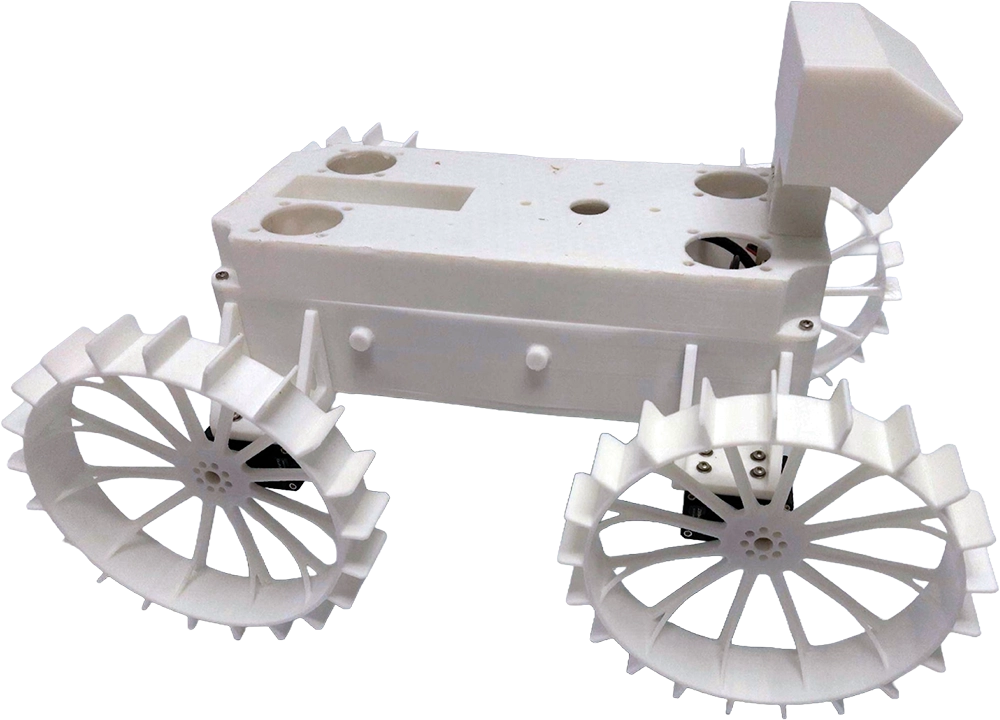
Engineering lecturer Amiel Hartman’s students 3D-printed a shoebox-sized rover to test navigation.
Moonwalkers
Engineering and computer science students used the Nvidia Omniverse platform to create a virtual lunar surface based on NASA satellite imagery, and used Autodesk Fusion 360 to create the textured terrain of the lunar south pole.
Then, the students created “digital twins,” simulated versions of their team of autonomous rovers that they called Moonwalkers, plus astronauts and support systems. The digital twins help with mission planning by showing how the machines would navigate the terrain on different missions. At one point, Li in France and students in Los Angeles and Singapore simultaneously oversaw rovers powered by different tech platforms. For one test, they even intentionally crashed two of the rovers.
“Most students who participate, they all get really great full-time jobs right after that project,” Li said.
Farming… in Space?
The grand prize winner at this year’s Anagnost College of Engineering and Computer Science Senior Design Project Showcase was a team of students who built a rover for construction projects on the moon.
Li and Jiang lead a project with Annette Besnilian and Andreas George of the Marilyn Magaram Center for Food Science, Nutrition and Dietetics in the College of Health and Human Development to build an autonomous space farming system. It uses a partially donor-funded robotic arm to grow self-pollinating crops such as Sugar Ann Snap Peas and Red Robin Tomatoes. An autonomous plant-growing system would free up astronauts to focus on other work.
Basu, the biology professor, is working on growing plants under stress and in microgravity. He wants to identify salad plants that need minimal water and can be grown for food on the International Space Station or elsewhere beyond Earth.
He and his students are also researching Halobacterium salinarum, a salt-loving species of microbes that can turn water pink or red. Basu is growing the microbes under harsh conditions — in extreme cold, with no light, in simulated Martian soil — to see what they can tolerate. He hopes they could be useful in developing survival systems in space. For example, if there was an antibody needed, these microbes could be engineered to synthesize it.
Basu also works with a renowned chemistry professor at UC Irvine, Alex Guenther, to study volatiles produced by the microbes (an example of a volatile is the carbon dioxide we exhale when we breathe), as a potential sign of life on other worlds.
“I have a T-shirt that says, ‘Are We Alone?’ and I am intrigued by that sentence,” Basu said. “My background is in genetic engineering. I always think that if microbes or plants could be genetically engineered to tolerate stress, they can be grown on another planet. If we can grow plants, it means plants not only produce food, but they can add oxygen back to the environment. We can breathe.”
‘From Ashes’
Technology has advanced so much that Ricci and his colleagues are doing things that weren’t possible even a few years ago. They use images from the most powerful telescopes on earth — plus the James Webb Space Telescope — to study new stars surrounded by disks of gas and dust. The dust and gases can clump together, eventually snowballing into planets.
“The beginning dust grains are dust in smoke, invisible basically, microscopically small,” Ricci said. “It’s quite amazing to think that it is out of that smoke that we have planets forming. We are seated on a planet that was smoke 4.5 billion years ago. We are trying to understand how this process works to go from ashes, or smoke, all the way to planets.”
The planets Ricci and his students have studied are still embedded in their parental disk and less than 10 million years old, which is very young on the timescale for life — it took about a billion years for life to appear on Earth. But when researchers look for places that could potentially host life, they look for planets or moons in the “habitable zone,” which sit far enough from their star, but not too far, where liquid water could exist. Life is also more likely to exist on rocky planets, like Earth, rather than a gas planet such as Jupiter.
Most new rocky planets are too small to be picked up even by the newest telescopes, but there are upgrades planned. Ricci and his students conducted computer simulations and found that the upgrades will be able to detect planets that may one day host life.
“Even in the most introductory textbooks, we have to update our material every year because of new discoveries,” Ricci said. “That is extremely motivating. It never feels old.”
Bringing it Home
NASA and the European Space Agency assembled an international team of about 25 researchers to draft rules for returning the samples safely, in case they contain living Martian microbes that could jeopardize life on Earth.
Mackelprang’s work with NASA, including the research in Alaskan permafrost, earned her a spot in this group. She led two subgroups and served as the lead corresponding author on a paper about the theoretical framework for their decisions.
They addressed questions such as: How would they detect life in samples? What tests can you do without using up most of the sample material? What if alien life is very different from Earth life — how might they detect that? And how certain do they have to be that there’s no life before they release a sample from a high-containment sample-receiving facility?
The team recommended tests that could find evidence of modern life, even if it is substantially different from life as we know it. (Theoretically, any kind of life would leave telltale patterns of organic molecules in soil.) The proposed testing methods are supported by Earth samples and meteorites.
If tests show a living species, Mackelprang said, an additional panel would be convened to determine next steps. It will be years before samples are brought back to Earth; the vehicles to retrieve them and the facility to hold them haven’t been built.
If evidence of life is found in samples returned from Mars, Mackelprang said it’s more likely that it would be extinct life, rather than current life. Finding evidence of either would help us understand ourselves and our place in the universe, she said.
“It would be one of the great discoveries in science.”