


By

Herstein
Awareness, Aspiration, Access


This is the moment Anagnost and several of his fellow alumni will inspect and judge each team’s Senior Design Project, and then they’ll name the winners of the 16th annual capstone competition for CSUN’s College of Engineering and Computer Science. Anagnost’s eyes twinkle, and he grins as he listens to the Matador students’ new take on an old challenge: How to deliver packages without carbon emissions or adding to traffic congestion?
This never gets old for Anagnost. The president and CEO of tech giant Autodesk, a leader in design and make software, returns each year without fail to volunteer and judge the Senior Design Showcase, because he knows what it means to these aspiring engineers, makers, dreamers. He knows that they know he once stood where they stood, because he’s refreshingly candid about his own CSUN path — which was anything but smooth or linear.
If I can do it, you can do it, he tells them.
Anagnost, 61, has made an indelible mark on his alma mater with one of the largest personal gifts in university history, a $20 million gift to the college. In recognition of his vision and generosity, on Aug. 22, CSUN renamed the college in his honor. Earlier in the summer, the California State University Board of Trustees approved the university naming the college the Andrew J. Anagnost College of Engineering and Computer Science. Under his leadership, Autodesk has donated more than $7 million to CSUN for the Autodesk Technology Engagement Center (ATEC), a nexus of innovation and exploration for K-12 and university students — whose grand opening also was celebrated Aug. 22.
“This represents a profound investment in our university’s future and the students we are so very proud to serve,” said CSUN President Erika D. Beck. “Andrew’s extraordinarily generous gift will reshape our college of Engineering and Computer Science for generations to come, creating boundless opportunities for students to discover their potential and thrive beyond our doors. It’s a gift that reflects his unwavering commitment to ensuring that future generations have access to world-class engineering and computer science education.”
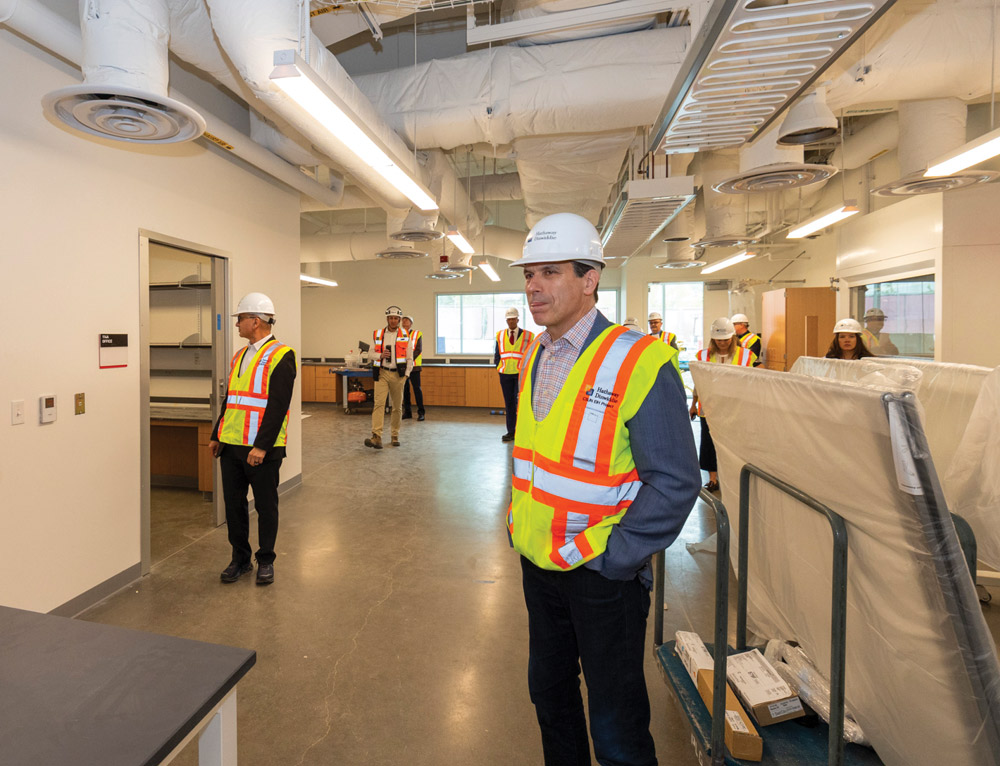
The Autodesk Technology Engagement Center, located on Lindley Avenue next to Jacaranda Hall, is a massive leap forward for academic programs in the college, and it hosts equity-focused STEAM (science, technology, engineering, arts and mathematics) programming — as well as programming for the new Global Hispanic Serving Institution (HSI) Equity Innovation Hub.
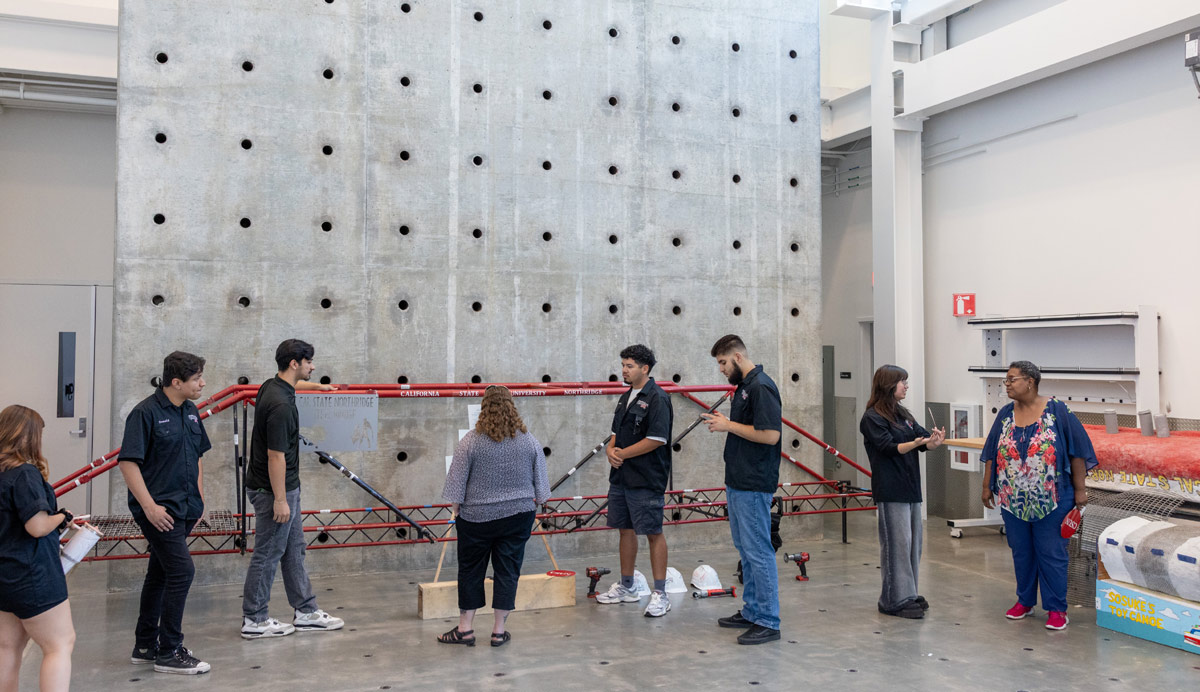
The facility features fabrication labs — including Anagnost’s favorite, a High Bay Structural Test Lab complete with an indoor, hydraulic “bridge crane” (more on that later) — as well as state-of-the-art research, design and digital capture labs, and a makerspace for the campus and wider community.
The Product of Immigrants
As the married father of two has shared with audiences large and small, CSUN was the catalyst in his meteoric rise from struggling San Fernando Valley high school student to Ph.D. from Stanford and NASA research fellow.
Growing up in Van Nuys, he dropped out of high school, a consequence of boredom and frustration. As a boy, he had dreamed of working for NASA, but as a teen, things seem to unravel.
After a series of run-ins with school authorities and juvenile detention officers, Anagnost searched his soul and changed his life. With the help of his father, an immigrant from Greece who worked as a social worker, and his mother, a nurse, he started fresh at a new high school and went from failing to straight A’s. Then, he set his sights on college. He enrolled at CSUN as an English major for “half a semester” before rediscovering his love of science, Anagnost said.
His lived experience as a student who took a long and winding road to engineering and computer science drives his passion for the student support the ATEC and new Global HSI Equity Innovation Hub programs will offer — not just to undergraduates, but to middle and high school students exploring STEAM careers.
“My dad was a social worker. He was never going to be able to support me through some of these things, but if I’d had the support that they’re [planning to] provide in the early parts of the [Hub] program — I would have had a different course,” Anagnost said. “This support piece at every step of the way, so students don’t fall off the rails and slip away, I know it’s expensive and hard to maintain. You can’t reach everyone, but you can reach somebody. And you can reach more people. That’s a really important part of this — you’ve got to help [students] along the journey, especially when they get discouraged.”
Anagnost’s family connection to CSUN runs deep, as his mother, sister and brother also earned degrees from the university.


Awareness
At CSUN, 56% of the student body identify as Latinx/Hispanic, and 72% are the first in their families to graduate from university. L.A. is a global city of immigrants, and Matadors long have reflected this diversity.
“I’m a product of immigrants, like most Americans are,” Anagnost said. “My father did things that his parents couldn’t even imagine, and his children went on to do things that they couldn’t imagine. If you miss those first-generation people, you’re missing a massive, highly motivated talent pool. Philosophically, this is a problem that must be solved.
“In the U.S., we graduate a lot of lawyers, accountants, finance people,” he said. “We need more people going into STEM-based careers. The country’s diversifying, the talent pool is broader and you have to bring that talent pool into the STEM world. It’s not just a moral imperative — it’s an innovation imperative.”
Immigrant families like his often don’t know what to tell their kids about STEM fields, or how to help their children get there, he noted.
“Do we only want our brightest technical thinkers to come from a pool of people where the parents knew what to tell their kids? That’s not a selection mechanism that gets us the best and brightest ideas,” Anagnost said. “You want people from diverse backgrounds to be aware of what is out there, and understand that they can do these careers, too.”
Aspiration
CSUN reignited that interest, putting him on the path to achieving his childhood dream of working at NASA, Anagnost explained. He worked at Lockheed Martin Aeronautical Systems Company straight out of CSUN, where he had participated in an honors co-op program before graduating. After a year and a half — and with CSUN’s support — he earned a master’s and doctorate in aeronautics and astronautics (known in the field as “aero/astro”) at Stanford University. Following his postdoc, he joined the startup Exa Corporation in Boston, further advancing his career.
Faculty, mentors (including peer mentors) and K-12 educators can show young people what’s possible — from outer space to right here on Earth.
“You need to show people that if you’re in a technical profession, you’re going to be tackling pressing problems that we have in the world: building infrastructure, fighting back on climate change, mitigating real threats to the prosperity of future generations,” Anagnost said. “You’re going to be able to make impacts on longevity, on health and all sorts of things that other people couldn’t imagine making impacts on, because technology has advanced so much. [We] want people to aspire to that.”


Access
“The biggest hurdle people have right now is mathematics,” he said. Access to tutors can help math students reduce practice and homework hours and streamline their learning, he said.
“Math terrifies some people because it’s conceptual, but it just requires work and support, and somebody telling you, ‘You can do it,’” he added.
Access to support and higher education, he said, are the antidotes.
“That’s why institutions like CSUN are so important,” he said. “[This is an] educational institution that can help [students] get there without saddling them with massive amounts of debt. That’s why the work we’ve done with ATEC was so important — not only to increase awareness and aspiration, but also to create first-class facilities that give people in these universities access to the latest and greatest technology. They have access to a lot more than I had when I was here.
“You can’t just hope for the outcome,” Anagnost said. “You have to create the awareness, you have to create the aspiration, and you have to provide the means of access to getting to it.”
Anagnost’s personal cumulative giving of more than $22.1 million represents the largest alumni contribution in CSUN’s history, establishing a new standard for alumni engagement and support. And through Anagnost’s stewardship, Autodesk has invested more than $10.2 million in corporate philanthropy at CSUN to empower the next generation of innovators through access to cutting-edge tools, research and industry collaboration.
A $25 million state budget allocation under California Gov. Gavin Newsom was made possible with support from U.S. Sen. Alex Padilla, then-Congressman Tony Cárdenas and Congresswoman Luz Rivas (then Assemblymember), who succeeded Cárdenas in California’s 29th District. Padilla also helped secure $1 million in federal funding for equipment.
And, with significant support from Apple Inc. as part of its Racial Equity and Justice Initiative — as well as from TOLD Foundation, the 1994 Blommendahl Family Trust and alumnus Varoujan Chakarian and family — the ATEC will house and be equipped to support programming for the Anagnost College, as well as the Global HSI Equity Innovation Hub program, which has launched initiatives in the region, statewide through the CSU system, and nationally.
“Accessibility is our vision, and this is Andrew’s vision as well,” said Houssam Toutanji, dean of the newly named Andrew J. Anagnost College of Engineering and Computer Science. “The very first time I met him in 2019, he mentioned: These labs [in Jacaranda Hall] were the same labs and looked the same as when he was a student here, and it’s time” for new facilities and resources. “He said, ‘We owe it to these students to provide them the very best, cutting-edge facilities.’ He never forgot what CSUN has done for him, and he never wavered about it: CSUN was good to me, and I have to give back,” Toutanji said.
The dean praised Anagnost’s consistency, follow-through and devotion to his alma mater and community. “And he doesn’t have to do it — he comes here every year to judge the Senior Design Showcase, takes the time out of his busy schedule,” Toutanji said.
ATEC is for Everyone
“Autodesk helped to realize this [ATEC] space, to make it a gateway for creativity, with the end goal of trying to diversify pathways that lead to careers in STEM and the creative and tech industries,” added Amanda Quintero, senior advisor to the president for inclusive excellence and equity innovation officer for the Equity Innovation Hub. “They made it possible for us to have the kind of 21st-century programming that will inspire a whole new generation of students, to learn these skills, apply them in a way that is fun, creative and gives them access to opportunities.”
The center’s new research labs are already increasing the college’s capacity for innovation. The clearest example also happens to be Anagnost’s favorite ATEC space: the 30-foot-tall High Bay Structural Lab, where civil, structural and materials engineering students can test concrete and conduct countless other experiments. It’s the first of its kind in the CSU system, and one of just seven or eight in the country.
“I really love the High Bay!” Anagnost said, grinning. “It’s got a crane and this huge concrete wall that required three test-pours to figure out. It’s a piece of engineering in a building about engineering!”
Anagnost wants everyone to take advantage of this new space.
“[ATEC] is meant for the entire community of the university. It’s not meant to just be the place where the engineers figure something out,” he said. “There’s a makerspace, there are creative spaces. Come and use the place, and experiment with making something. You don’t have to be an engineering major or STEM major. You’ll be surprised what you find.”
He reminisced about his CSUN student days, when he had many friends who were art majors. Some went on to become painters in Hollywood and special-effects artists.
“I found out that my fluid-dynamics professor, Mel Epstein, was running a computer graphics lab in one of the back rooms of Jacaranda Hall, and the art students were coming there and hanging out with him, to work on computer graphics,” Anagnost said. “It was really cool! Somehow, these two groups started talking to each other. You just never know how your world expands when you cross-pollinate people from different academic orientations.”